


An OSD tank is an on-site stormwater detention tank: a storage structure that temporarily holds stormwater from a property and releases it slowly into the public drainage system. It stops new roofs and paving from sending a surge of runoff into drains that weren’t built for it.
Many NSW councils, and Sydney Water in parts of Sydney, require OSD for new developments to reduce the risk of downstream flooding. An OSD tank is not a rainwater tank. A rainwater tank keeps water for reuse, while an OSD tank is designed to empty after each storm so it is ready for the next one.
OSD tanks can be cast in situ in concrete, precast, made from modular plastic units, or built above ground. A hydraulic engineer sets their size and outlet to meet council or Sydney Water limits.
What Is an OSD Tank and How Does It Work in Stormwater Management?
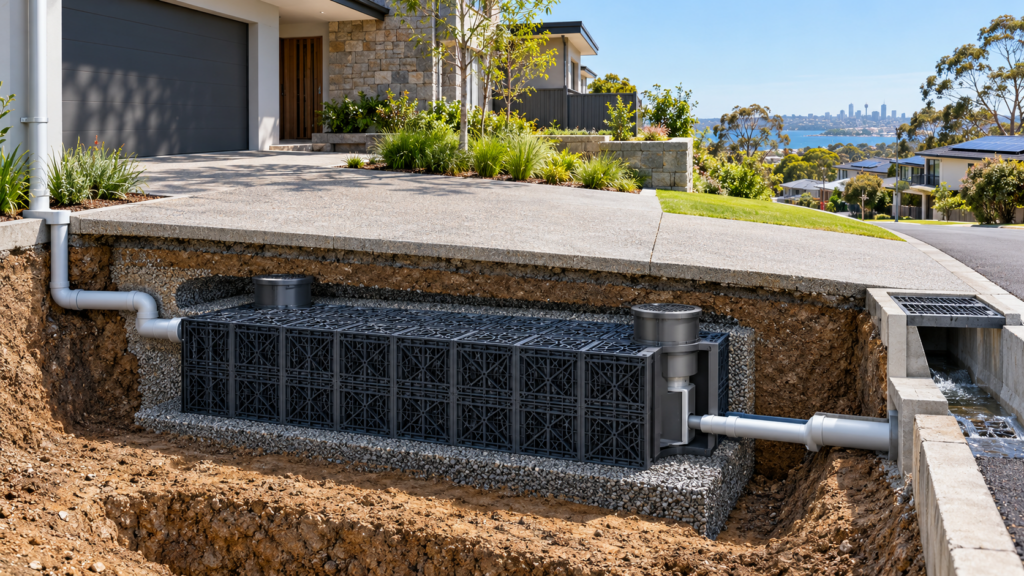
An OSD tank collects stormwater from roofs, driveways, and paved areas during heavy rain, stores it briefly, and releases it at a controlled rate no higher than the site’s limit. Once the storm passes, the tank drains empty.
Why is OSD needed
Hard surfaces send rain into drains much faster than gardens and lawns do. As more lots are developed, peak flows in the public stormwater network increase, which can overload pipes and exacerbate local flooding. Sydney Water’s on-site stormwater detention guide explains that OSD temporarily stores runoff so that a development’s discharge suits the drainage system it connects to.
How an OSD system works
- Rain falls on roofs, driveways and paving.
- Gutters, downpipes, pits and pipes carry it to the OSD tank.
- The tank’s outlet is restricted, usually by an orifice plate (a plate with a precisely sized hole), so only a set flow can leave.
- During a storm, water backs up and fills the tank.
- Water drains out at the controlled rate to the kerb or a council or Sydney Water pipe.
- In very large storms, an overflow sends excess water along a safe, planned path.
- After the storm, the tank empties and is ready for the next one.
Simplified illustration, not to scale. Tank layout, outlet, overflow and connection details are set by the approved hydraulic design.
Key terms and components
- Permissible site discharge (PSD): the maximum rate at which water may leave the site, usually in litres per second.
- Site storage requirement (SSR): the volume of storage the site must provide, usually in cubic metres.
- Orifice plate: the outlet restriction that controls the discharge rate, usually protected by a screen or trash rack, so it doesn’t block.
- Overflow: the planned escape route, including an overland flow path, for storms bigger than the design.
- Inlets and bypass areas: the pipes and pits feeding the tank, and any parts of the site that don’t drain to it.
- Internal falls: slopes inside the tank so it drains fully.
OSD vs rainwater tanks vs retention
A rainwater tank stores water for reuse and is meant to stay full. An OSD tank is meant to be empty between storms. Some councils allow on-site retention, which keeps water for reuse, in place of OSD for certain developments. Inner West Council’s stormwater controls, for example, allow retention to replace OSD for single dwellings in line with its tables. If you want one tank to do both jobs, ask your council whether a combined reuse-and-detention tank is permitted.
What Are the Different Types of OSD Tanks Used in NSW Construction?
The main OSD tank types in NSW are in-situ concrete tanks, precast concrete tanks, plastic modular systems, and above-ground storage tanks. Which one suits depends on the required volume, available space, loads above the tank, access, and council rules.
In situ concrete OSD tanks
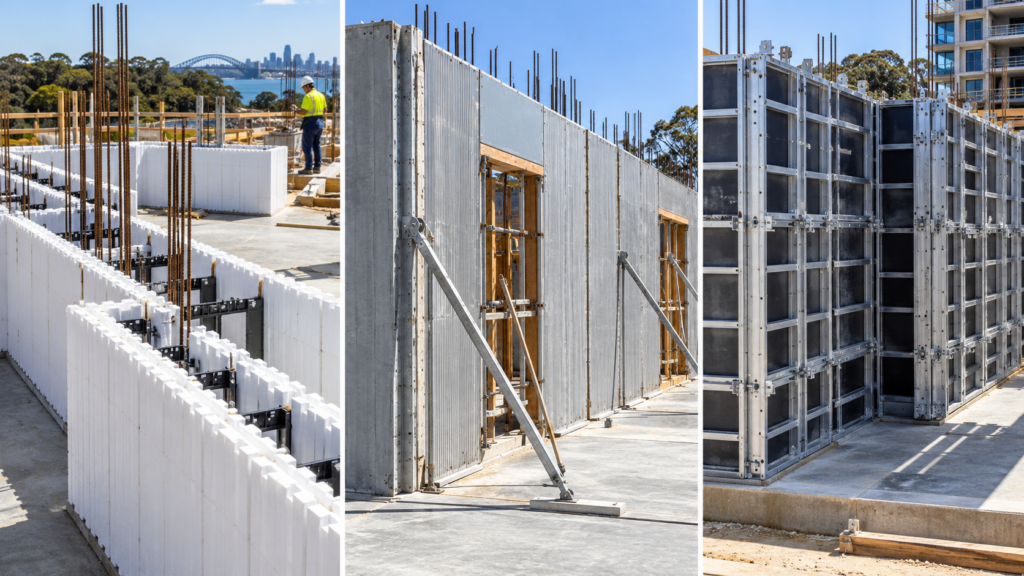
In situ tanks are reinforced concrete boxes cast on site, often below a driveway or under a building. They can be shaped to fit awkward sites, built under trafficable areas, and tied into building structures. They need excavation, formwork, reinforcement, concrete placement and curing, and their walls, base and roof slab must be engineered for soil, water and traffic loads. Permanent formwork is one way to build the walls. Rise Products lists pits and tanks as applications for Rise Wall.
Precast concrete OSD tanks
Precast tanks are made in a factory and delivered as complete units or segments, then craned into an excavation. They can be quickly installed where the site allows truck and crane access, and a standard size fits. Joints between segments, connections and lifting all need planning, and tight sites may rule out large units.
Plastic modular OSD systems
Modular systems use plastic cells or crates assembled into a block, wrapped in a membrane or geotextile and buried. They are light and flexible in layout, but rated load capacity, cover depth, inspection access and cleaning need careful checking. Not every council accepts every system, so confirm before designing around one.
Above-ground OSD tanks and storage
Some sites use above-ground tanks or surface storage, such as a shallow landscaped or paved area designed to pond briefly in a storm. These avoid deep excavation but use valuable site area and must meet council rules on depth, location and safety.
| Tank type | Typical construction method | Space and access | Main advantages | Potential limitations | Important design checks |
| In situ concrete | Reinforced concrete walls, base and roof cast on site | Needs excavation, working room and concrete truck or pump access | Fits odd-shaped sites; can sit under driveways and buildings | Formwork, reinforcement and curing time | Structural design, joints, penetrations, roof slab loads, and access covers |
| Precast concrete | Factory-made units or segments craned into place | Needs truck and crane access to the excavation | Fast placement once manufactured | Transport, lifting, standard sizes and joint sealing | Capacity, segment joints, load rating, lifting plan |
| Plastic modular | Plastic cells assembled into a wrapped block and buried | Lighter handling; flexible layouts possible | Light and adaptable | Load rating, cover depth, cleaning access, council acceptance | Traffic and soil loads, inspection and cleaning access, and product approval |
| Above ground | Tanks or shallow surface storage areas | Uses the site area at the ground level | Avoids deep excavation | Takes up usable space; depth and safety rules | Council acceptance, overflow path, safety, and appearance |
Underground tanks are often chosen when outdoor space is limited because the area above can still be used as a driveway, courtyard, or garden. No single type is best for every site.
For more on concrete pits and tanks built with permanent formwork, see Rise Wall’s pits and tanks page.
What Are the Design, Sizing and Drainage Requirements for OSD Tanks?
A hydraulic or civil engineer designs OSD tanks to meet two numbers set by the council or Sydney Water: the permissible site discharge (how fast water may leave) and the site storage requirement (how much must be held back). The design then has to work structurally, drain properly and stay maintainable.
How is OSD tank capacity calculated?
Sizing methods differ between authorities. Sydney Water’s guide sets out its own design requirements for sites connecting to its or the City of Sydney’s stormwater assets and also tells applicants to check council requirements. Councils publish their own methods in their development control plans. Ku-ring-gai Council’s water management DCP, for example, includes permitted site discharge and minimum storage controls, a calculation method, design rules and an exemption map.
Inputs typically include site area, the area of roofs and paving, how much of the site drains to the tank, and the local rainfall data. Engineers often model the system with drainage software before finalising the tank, specifying the storage volume, maximum water level, orifice and screen, overflow path and street connection.
Structural and construction requirements
Buried concrete tanks must be engineered for soil and groundwater pressure, uplift (buoyancy) when the ground is wet, and the tank is empty, and any vehicle loads above. Roof slabs under driveways need traffic-rated design and access covers. Joints and penetrations should be detailed so groundwater doesn’t leak in and stored water doesn’t leak into nearby footings.
Before digging, confirm the site levels and excavation depth, ground conditions, groundwater, underground services, and the approved discharge point. The hydraulic, civil, and structural designs need to align. Changing site levels, adding paving, or moving a downpipe after approval can affect how much water reaches the tank, so check any changes with the designer before building.
Access and safety
OSD tanks are confined spaces. Designs need access openings and covers big enough for inspection and cleaning, positioned over the orifice and screen, with signage and secure lids.
Does OSD always work?
OSD’s benefit depends on the catchment. Research from the University of Technology Sydney modelling the Sheas Creek catchment found the expected benefits were unrealistic in some cases, and council exemption maps reflect the same point: local conditions matter.
How Much Does an OSD Tank Cost to Install in NSW?
There is no reliable single price for an OSD tank. The cost depends on the required storage volume, tank type, depth and excavation, ground conditions, site access, loads above the tank, design and certification, and how it connects to the street. Get itemised quotes based on the approved hydraulic design.
What factors affect OSD tank installation costs?
The biggest variables are usually how much storage the site must provide and how hard it is to dig. A small tank on an open suburban lot is a very different job from a deep tank under a basement driveway beside neighbouring buildings. Rock, groundwater, and the need for shoring can sharply affect the cost.
| Cost item | Main cost driver |
| Hydraulic design | Site complexity, modelling and council requirements |
| Structural design | Depth, soil, groundwater and loads above |
| Excavation and disposal | Volume, rock, access and spoil removal |
| Shoring and dewatering | Depth, neighbours and groundwater |
| Tank construction | Type: in situ, precast, modular or above ground |
| Formwork (in situ) | Temporary or permanent formwork, labour and stripping |
| Roof slab and covers | Traffic loads and access requirements |
| Pits, pipes and outlets | Distance and depth to the street or council pipe |
| Orifice plate and screen | Fabrication and installation |
| Connection works | Kerb, council or Sydney Water connection |
| Certification and works-as-executed | Inspections, surveys and engineer sign-off |
| Title registration | Positive covenant or agreement on title |
How do different OSD tank types compare in cost?
| OSD tank type | Main cost drivers | Installation considerations | Information needed for an accurate quote |
| In situ concrete | Excavation, formwork, reinforcement, concrete, roof slab | Curing time, concrete access, and working room in the excavation | Approved drawings, volume, depth, loads above, soil report |
| Precast concrete | Unit supply, transport, crane hire, joint sealing | Truck and crane access, lifting plan, standard sizes | Volume, site access, crane position, depth, and connection details |
| Plastic modular | Cell supply, wrapping membrane, bedding and backfill | Load rating, cover depth, cleaning and inspection access | Volume, traffic loads, cover depth, and approved product |
| Above ground | Tank or surface works, landscaping, overflow | Space, appearance, safety and council acceptance | Volume, location, overflow path, council conditions |
How can you plan an OSD tank budget more effectively?
Compare quotes for the same storage volume, depth, loads, access, and inclusions, and check whether engineering, excavation, shoring, the roof slab, the street connection, certification, and reinstatement are included. The cheapest tank to buy isn’t always the cheapest to install, because higher excavation, lifting, or reinstatement costs can offset a low supply price.
Where the construction method affects cost
For in situ concrete tanks, the formwork method affects labour, programme and site handling. Permanent formwork eliminates the stripping stage, which can be critical in deep, confined excavations. Any savings depend on the project, so compare the full installed prices. Rise Products discusses its system on the Rise Wall difference page.
What Are the Council Approval and Maintenance Requirements for OSD Tanks in NSW?
OSD rules in NSW are set by each council, and by Sydney Water where a site drains to its assets. Whether you need OSD, how big it must be, and how it must be maintained all depend on your council and your site. Rules change, so always check the current version with your council before designing. The sources below were checked in October 2026.
Who sets the rules?
- Councils set OSD requirements in their development control plans (DCPs) and engineering specifications, and assess the design as part of a development application or complying development.
- Sydney Water sets requirements for sites that connect to its stormwater assets or are within the City of Sydney LGA. Its OSD policy says the system must be site-specific and offset the runoff from the development.
Do all properties in NSW require an OSD tank?
No. Whether you need OSD depends on your council’s development controls, the size of the development and how much it changes the site, local discharge constraints, site drainage conditions, and any conditions attached to your development consent. Some examples:
- Sydney Water’s policy states that a site may be exempt if its original total area is less than 250 square metres or if it is located in the lower section of the catchment.
- Inner West Council’s DCP requires OSD for all developments except in listed cases, such as sites draining directly to the Cooks River, Parramatta River or Sydney Harbour, or where on-site retention replaces it.
- Ku-ring-gai Council’s DCP includes an OSD exemption map.
Not every NSW property needs an OSD tank, but many new homes, duplexes, townhouses and apartment developments in Sydney do.
What documentation may be required for OSD approval?
Applications generally include hydraulic plans showing the tank’s location relative to the development and site drainage; plans and elevations of the tank; PSD and storage calculations; the orifice and overflow details; and the connection to the street or public drain. After construction, councils commonly require a works-as-executed survey and an engineer’s certificate that the system was built as approved.
General guidance like this is not the same as your approval. Your development consent or Sydney Water approval may impose site-specific conditions, so follow them first and confirm the exact requirements with your council and project engineer.
How should an OSD tank be maintained?
The property owner is responsible for keeping the OSD system working. The NSW business licence guidance on OSD approval notes that if a system discharges directly into a Sydney Water drain, the owner must sign a formal maintenance agreement registered on the property title. Where it discharges to a council drain, the council may require its own agreement. Councils may also require a positive covenant or restriction on title so the obligation passes to future owners.
Typical maintenance includes:
- removing leaves, sediment and debris from inlets, pits and the tank
- inspecting screens and the orifice plate for blockages
- Checking the overflow path is clear
- looking for damage, cracking or deterioration in pits, covers and the tank
- inspecting after significant rainfall
- keeping maintenance records and following any approved maintenance instructions.
OSD tanks are confined spaces, so cleaning inside the tank should be done by people trained and equipped for confined space work.
[Photos to be supplied: approved Rise Wall pit and tank photos. See the editor notes.]
Planning an OSD Tank for Your NSW Project?
An OSD tank protects the public drainage network by holding back stormwater and releasing it slowly. The right system depends on your site, the required storage, the construction method and your council’s rules:
- OSD tanks temporarily store runoff and control its release; they are not rainwater tanks.
- In situ concrete, precast concrete, plastic modular, and above-ground options each have distinct strengths and limitations.
- Tank size and drainage design need a project-specific assessment by a qualified engineer.
- Installed cost depends as much on the site works as on the tank itself.
- Council requirements and maintenance obligations should be confirmed before construction.
For in situ concrete tanks and pits, permanent formwork systems such as Rise Wall are one construction option to discuss with your engineer.
Planning an in situ concrete OSD tank, pit or below-ground stormwater structure? Speak with Rise Products about whether Rise Wall permanent formwork suits your design. Share your hydraulic and structural drawings, tank dimensions and site details to discuss product suitability and project-specific pricing.
Get a Quote or call 1300 205 541.
Frequently Asked Questions
What is an OSD tank, and why is it required?
An OSD tank temporarily stores stormwater from a property and releases it slowly through a restricted outlet. Councils and Sydney Water require it for many developments because new roofs and paving increase runoff, which can overload public drains and exacerbate downstream flooding. The tank limits the site’s peak flow to an approved rate.
How does an OSD tank differ from a rainwater tank?
A rainwater tank stores water for reuse, such as for toilets, laundry, or the garden, and is meant to stay as full as possible. An OSD tank is designed to empty after each storm, so it has room for the next one. Some councils allow combined or retention systems, but the detention part must still work as designed.
How much does an OSD tank cost in NSW?
There is no reliable average figure. Cost depends mainly on storage volume, tank type, depth, ground conditions and site access. Get itemised quotes based on your approved hydraulic design, and check what each includes and excludes.
Do all properties in NSW require an OSD tank?
No. Requirements depend on your council, your location in the catchment, site size and the type of development. Sydney Water may exempt small sites or sites low in the catchment, and some councils publish exemption maps. Check your council’s DCP.
Can permanent concrete formwork be used to construct an OSD tank?
Yes, for suitable in situ concrete tanks. Permanent formwork can form the walls, which are then reinforced and filled with concrete. Rise Products lists pits and tanks as applications for Rise Wall. The tank must still be designed by a structural engineer, with joints, penetrations and the roof slab detailed for the site.
Who can help design and install an OSD tank?
A hydraulic or civil engineer designs and certifies the system; a structural engineer designs buried concrete tanks; and the builder, tank or formwork supplier, and drainage contractors build it. Agree early who is responsible for design, approvals, construction and certification.