



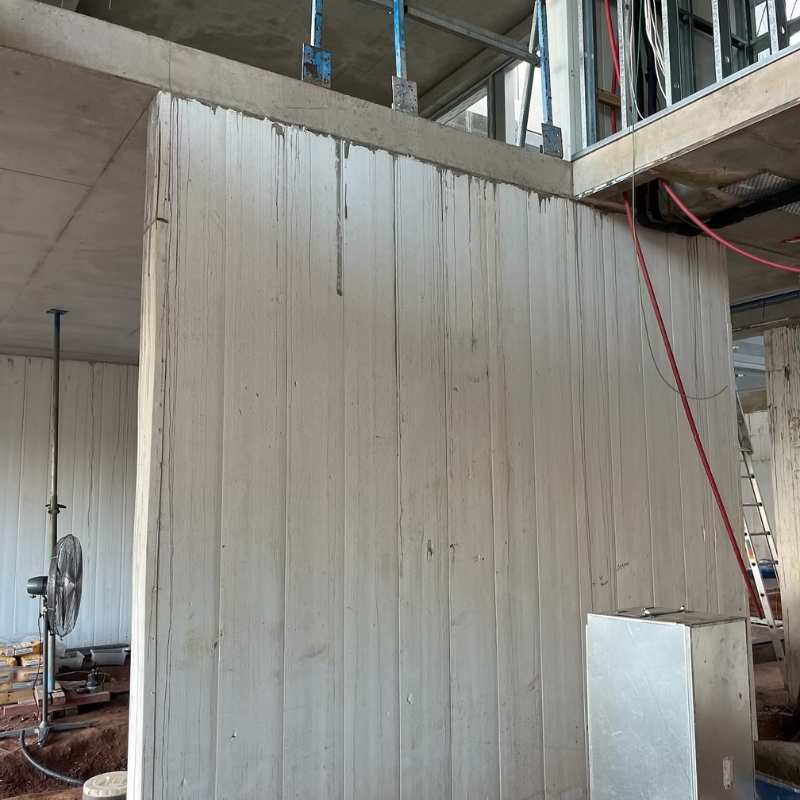
For builders, developers, and estimators, formwork design means walling costs are no longer just about the supply rate of blocks, panels, concrete, or reinforcement. The real cost of a wall system is the installed cost: labour, handling, bracing, freight, sequencing, waterproofing, defects, and programme risk.
Concrete masonry blockwork remains a familiar and proven option across Australia and the U.S. It is widely understood, readily available, and suitable for many wall applications. But on projects where labour availability, site congestion, programme speed, or waterproofing risk are major cost drivers, permanent formwork systems can offer a compelling alternative.
This article compares traditional blockwork with lay-flat permanent formwork systems, including systems such as Rise wall application, from a whole-of-project cost perspective.
Why supply-only pricing can be misleading
A low material rate can look attractive at the tender stage, but it may not reflect the true cost of getting the wall built, poured, waterproofed, and ready for the following trades.
For wall systems, the biggest cost differences often appear in:
- labour hours
- installation speed
- bracing and propping requirements
- crane and lifting demand
- freight volume and storage
- waterproofing scope
- rework and defect risk
- programme delays
This is why a walling option with a higher supply cost can still deliver a lower installed cost if it reduces labour, handling, and time on site.
Blockwork vs lay-flat permanent formwork
| Cost factor | Concrete blockwork | Lay-flat permanent formwork |
| Labour | Labour-intensive manual installation | Faster panel-based installation |
| Site handling | Heavy blocks, pallets, mortar, reinforcement and grout | Lightweight panels that are easier to move and position |
| Bracing and propping | May require temporary support and staged filling depending on the wall design | System-specific bracing requirements are often designed to simplify installation |
| Programme | Sequential process: set out, lay blocks, reinforce, core fill, cure, waterproof | Panels can be installed quickly and filled as part of a streamlined sequence |
| Freight and storage | Bulky pallets take up significant truck and site space | Lay-flat panels can improve freight efficiency and reduce site congestion |
| Waterproofing | Multiple joints and penetrations can increase detailing requirements | Smoother wall faces may reduce detailing complexity, depending on the system |
| Defects and rework | Mortar joints, alignment, cracking and grout issues can create rework | Panel alignment and pour quality remain critical, but fewer masonry joints may reduce some risks |
| Installed cost | Often competitive when labour is available, and programme pressure is low | Can be more cost-effective where speed, access, labour, and logistics matter |
Labour: the biggest difference on many projects
Blockwork is proven, but it is labour-heavy. A typical block wall requires careful set-out, block laying, mortar preparation, reinforcement placement, core filling, curing, and often follow-up works before waterproofing or finishing can begin.
Permanent formwork changes the labour profile. Instead of laying individual blocks course by course, crews assemble panels, place reinforcement, brace as required, and pour concrete into the permanent formwork. The result can be a faster installation sequence with fewer manual handling steps.
The exact labour saving depends on wall height, reinforcement design, access, crew experience, bracing requirements, and concrete pour methodology. However, on suitable projects, this is often where permanent formwork delivers its strongest commercial advantage.
Freight and storage
Freight is often overlooked in early comparisons. Concrete blocks are heavy, bulky, and usually delivered on pallets. They require space for unloading, storage, lifting, and staging. On tight urban sites, this can affect crane usage, access routes, traffic management, and productivity.
Lay-flat permanent formwork systems are designed to reduce transport volume. More wall area can typically be carried per truck compared with bulky masonry units, which may reduce deliveries, handling time, and storage pressure.
This benefit becomes more valuable on:
- remote projects
- congested urban sites
- multi-storey builds
- projects with limited laydown area
- sites where crane time is expensive or tightly scheduled
For a deeper dive into logistics advantage, see our piece on lay-flat formwork cost reduction.
Bracing and programme risk
Programme cost is not always visible in a wall rate, but it can be one of the most important commercial factors.
Blockwork can involve multiple work stages before the wall is ready for the following trades. Delays in labour availability, wet weather, core filling, curing, access, or inspection can push out the programme.
Permanent formwork can reduce some of this sequencing risk by allowing faster wall assembly and a more streamlined concrete pour process. That can help bring forward waterproofing, backfilling, slab works, framing, or services, depending on the project sequence.
The faster the wall package is completed, the sooner other trades can move through the site.
Waterproofing and defect risk
Waterproofing is another area where the lowest wall supply price may not produce the lowest finished cost.
Blockwork contains many joints. In basements, retaining walls, lift pits, and below-ground structures, those joints need careful treatment. Poor detailing or movement at joints can increase the risk of water ingress and callbacks.
Permanent formwork systems may provide smoother wall faces and fewer masonry joints, which can simplify some waterproofing details. However, waterproofing requirements should always be confirmed by the project engineer, the waterproofing consultant, the manufacturer, and the relevant code requirements.
A fair comparison should include:
- membrane area
- surface preparation
- primers and detailing
- joint treatment
- penetrations
- curing time
- inspection requirements
- defect and callback risk
Cost comparison: a practical 2026 view
Because labour, freight, and material prices vary by region, it is more useful to compare cost categories than to publish a single square-metre rate.
| Cost component | Blockwork baseline | Permanent formwork potential |
| Material supply | 100 | May be higher |
| Labour | 100 | Often lower |
| Freight and storage | 100 | Often lower |
| Bracing and temporary works | 100 | Project-specific, often reduced |
| Waterproofing preparation and detailing | 100 | May be reduced depending on the wall design |
| Programme risk | 100 | Often lower on suitable projects |
| Total installed cost | 100 | Potentially lower where labour, logistics, and programme savings offset material cost |
The key point is that permanent formwork should not be judged on material price alone. The right comparison is the installed cost, including the time and risk required to complete the wall package.
Where permanent formwork is most likely to perform well
Lay-flat permanent formwork is most attractive where speed, access, and labour efficiency matter. Common applications include:
Basements and retaining walls
Below-ground walls often involve waterproofing, reinforcement, bracing, and tight sequencing. A faster wall system with fewer masonry joints can offer commercial and programme advantages.
Remote and regional projects
Where freight and labour availability are major constraints, reducing deliveries and manual handling can improve overall project efficiency.
High-rise and multi-storey projects
On congested sites, reducing crane time, pallet storage, and trade congestion can support a faster and cleaner programme.
Labour-constrained markets
Where skilled masonry labour is difficult to secure, panel-based systems can provide an alternative installation pathway for suitable wall types.
Common mistakes when comparing wall systems
| Mistake | Why it matters | Better approach |
| Comparing only material supply rates | Ignores labour, freight, bracing, and programme cost | Compare the total installed cost |
| Assuming the same installation sequence | Different systems use different labour and pouring methods | Build a system-specific programme |
| Ignoring freight and handling | Bulky materials can create hidden costs | Compare wall area per delivery and site handling requirements |
| Using the same waterproofing allowance | Jointing and surface conditions can differ | Review the actual waterproofing specification |
| Copying reinforcement from one system to another | Structural requirements may vary | Get project-specific engineering advice |
| Assuming code compliance is automatic | Compliance depends on design, evidence, and approvals | Confirm suitability with the engineer, certifier, and product documentation |
Code and compliance considerations
Permanent formwork systems can be used where they are designed, specified, and installed in accordance with the relevant building code, engineering requirements, and manufacturer documentation.
For Australian projects, this means demonstrating compliance with the National Construction Code and relevant Australian Standards. For U.S. projects, this means satisfying the applicable building code, project specifications, and local authority requirements.
Builders should confirm:
- structural design requirements
- fire-resistance requirements
- concrete specification
- reinforcement design
- bracing and pour methodology
- waterproofing compatibility
- installation documentation
- certification or product evidence
- engineer and certifier approval
No wall system should be treated as automatically compliant without project-specific review.
FAQs
Are permanent formwork panels always cheaper than blockwork?
No. Permanent formwork is not automatically cheaper on every project. It is most competitive where labour, freight, access, bracing, waterproofing, or programme pressure are significant cost drivers.
Do higher material costs wipe out the savings?
Not necessarily. Even if the panel supply cost is higher than blockwork, savings in labour, handling, freight, and programme time may offset the difference. The only reliable way to compare is to price the full installed wall package.
Is permanent formwork suitable for basements?
It can be suitable for basements and retaining walls, subject to structural design, waterproofing requirements, site conditions, and compliance approval. These applications are often where the logistics and waterproofing benefits are most valuable.
Does permanent formwork meet fire requirements?
Fire performance depends on the wall build-up, concrete core, wall thickness, reinforcement, linings, penetrations, and the required fire-resistance level. Fire compliance should be confirmed using project-specific documentation and approvals.
Can permanent formwork be used in Australia and the U.S.?
Yes, permanent formwork systems can be used in both markets where they are properly designed, documented, and approved for the project. Compliance should be confirmed by the project engineer, certifier, and relevant authority.
Final takeaway
Blockwork remains a proven and familiar walling method, but its true cost is not limited to the price of blocks. Labour, freight, bracing, waterproofing, defects, and programme delays can all change the commercial outcome.
Lay-flat permanent formwork systems offer a different cost profile. On suitable projects, they can reduce labour demand, improve freight efficiency, simplify site handling, and help accelerate the construction programme.