



Water ingress is still one of the most expensive latent defects in Australian construction. When a basement leaks, the membrane gets the blame, and the waterproofer gets the call. But basement wall waterproofing is decided long before a membrane is specified. It is decided when you choose the wall system.
Core-filled blockwork is porous. Traditional formwork leaves a face that has to be ground, patched and prepped before anything can bond to it. A lay-flat permanent formwork system is highly water-resistant from the moment it is poured, and typically needs around 70% less waterproofing than blockwork. That is not a detailing tweak. That is a line item that largely disappears.
Where leaks actually begin
Below-grade water finds the weakest path, and it has decades to look. On a blockwork wall, it does not have to look hard.
- Mortar joints. Every course is a potential capillary path, and a block wall is nothing but courses
- The blocks themselves. Concrete masonry absorbs water, so the material is working against you before a single joint fails
- The render coat. One more layer, one more bond, one more thing to debond under hydrostatic pressure
- Rushed sequencing. A membrane applied over a face that was not properly prepped is a callback with a delay fuse on it
Traditional formwork removes the mortar joints but adds its own problems. The concrete has to cure, the forms come off, and then someone has to make the raw face acceptable for a membrane. Grinding, patching and slurry coats are days of work that exist purely to undo what the formwork did.
Why does a permanent PVC face change the equation
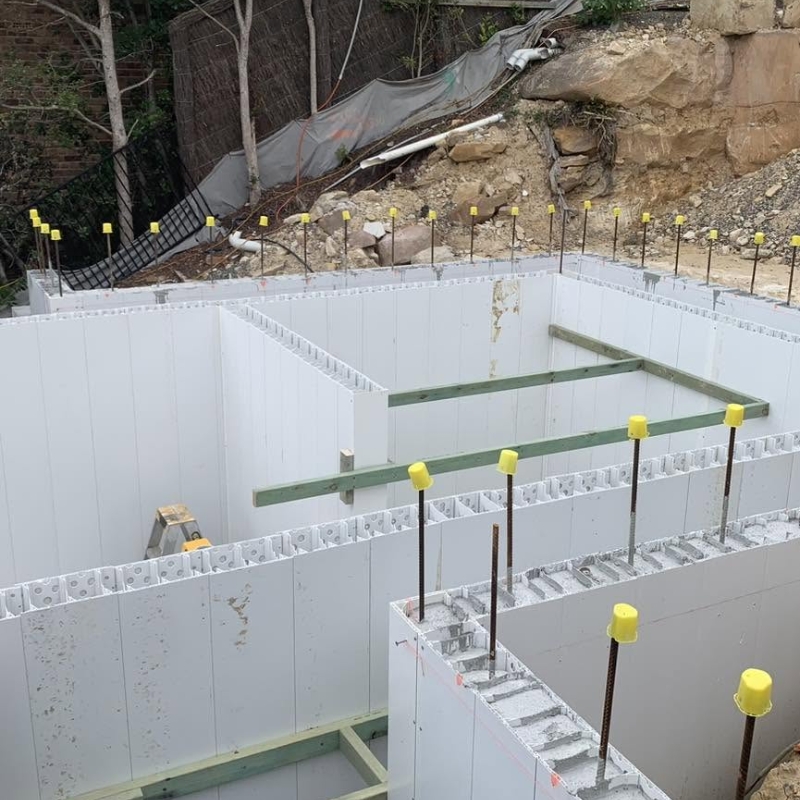
Rise Wall is a lay-flat, stay-in-place PVC formwork system. Panels stand, reinforcement goes in the cavity, concrete gets poured, and the PVC stays as the permanent face of the wall.
PVC does not absorb water. That single material property is why the finished wall is highly water-resistant and why a Rise Wall typically requires around 70% less waterproofing than a comparable blockwork wall. There is no porous masonry to seal, no mortar joint network to chase and no render coat to debond. There is also nothing to strip, so the face that comes out of the pour is the face you keep.
The saving lands twice. Once in membrane material, once in the labour and programme time that would have gone into preparing a surface and applying it.
Full detail on the water resistant permanent formwork wall system and its in-ground applications.
Formwork and waterproofing compared
| Waterproofing factor | Core-filled blockwork | Traditional formwork | Rise Wall lay-flat PVC |
| Wall face | Porous block and mortar | Stripped concrete, then prepped | Permanent PVC, water-resistant |
| Membrane load | Full external membrane | Full external membrane | Up to 70% less waterproofing |
| Leak paths | Every mortar joint | Cold joints and form seams | Sealed panel system |
| Prep before membrane | Render coat | Grind, patch, slurry coat | None, the face is the substrate |
| Install speed | Slow, block by block | Build, pour, strip, clean | Up to 70% faster |
| Installed cost | High labour and trades | Skilled crew paid twice | Up to 30% lower |
Hydrostatic pressure and below-grade walls
Basement walls do not deal with rain. They deal with sustained head pressure from saturated ground, which is a different and less forgiving problem. Rain stops. Groundwater does not.
Two things matter under that load. The wall has to be structurally consistent, and it has to be materially resistant. Rise Wall delivers on both. The finished element is a reinforced concrete core inside a permanent PVC skin, around twice as strong as blockwork, and it moves less during the pour because it needs less bracing to hold its line. A wall that holds its line pours consistently, and a wall that pours consistently does not develop the localised thin spots and honeycombing that seepage exploits.
Then the PVC face does the rest. A porous wall under constant pressure will eventually find a path. A water resistant one has far fewer to find.
Where the waterproofing risk is highest
| Application | Water exposure | Why does the formwork choice decide it |
| Basement walls | Sustained hydrostatic head | A porous wall under constant pressure will find a path. A water resistant face removes most of them |
| Retaining walls | Wet ground, seasonal saturation | Blockwork wicks moisture through joints for the life of the wall |
| Pits and tanks | Continuous contact | Every joint is a liability, so fewer joints is the whole game |
| Lift and stair shafts | Below-grade seepage | Leaks surface late and in the worst places to rectify |
The compliance conversation
Water-tightness has been climbing the risk register for years, pushed by defect litigation, insurance scrutiny and certifiers who have seen too many basements rectified after handover. Specifiers are being asked to show their working.
Under NCC 2022, the performance requirement for roofs and external walls preventing water penetration sits at F3P1 in Part F3, which replaced the FP1.4 clause number used in NCC 2019. That clause governs above-ground weatherproofing. Below-grade waterproofing and rising damp sit under Part F1 of Volume One. Confirm the applicable pathway with your certifier for the specific element, because a basement wall and an external facade are not assessed against the same requirement.
What does not change is the question a certifier will ask: how does this wall system limit voids, joints and penetrations, and is the surface suitable for the nominated membrane without additional preparation? A permanent formwork system with a water resistant face gives you a cleaner answer to both than a block wall does.
Rise Wall is fully tested and certified to comply with concrete formwork standards. For bracing and strike requirements on Australian sites, the Safe Work Australia formwork code of practice is the reference point.
The cost case, not the panel price
It is tempting to compare wall systems on supply rate. That comparison is the reason so many projects end up paying for waterproofing twice.
Price the wall in place. A Rise Wall lands up to 30% below the installed cost of the alternatives, and waterproofing is one of the reasons why. Add the rest, and the gap widens:
- Up to 70% faster to install, so the wall stops holding up the trades behind it
- Less labour, with no licensed blocklaying crew to book
- Less bracing, because the system is stronger and holds its own line
- Up to 5 times more wall per load, because the panels lay flat
- Minimal waste, with reusable offcuts and no strip-out phase
And then the quiet one. The phone that does not ring eighteen months after practical completion, because the wall is not leaking into a plant room.
The bottom line
Waterproofing is not a trade you bolt on at the end. It is a consequence of decisions made when the wall system was chosen. Choose core-filled blockwork, and you have chosen a porous wall, a render coat, a full membrane and the remedial risk that comes with all three. Choose a lay-flat permanent formwork system, and you have chosen a water-resistant wall that installs up to 70% faster, costs up to 30% less installed, and needs up to 70% less waterproofing.
Frequently asked questions
Does permanent formwork still need waterproofing?
It typically needs around 70% less than core-filled blockwork. Rise Wall is highly water resistant when installed to the recommended process, which removes most of the membrane load rather than all of it. Confirm the specification for your specific application.
Why is blockwork a waterproofing risk?
Concrete masonry absorbs water, and every mortar joint is a potential path. Under sustained hydrostatic pressure below grade, there are a large number of opportunities for water to find its way through.
Is permanent formwork suitable for basement walls?
Yes. The finished element is a reinforced concrete wall with a permanent water-resistant face, which suits basements, retaining walls, pits, tanks and lift shafts.
Does the PVC face need preparation before a membrane?
No grinding, patching or slurry coat is required as there is no formwork to strip. Confirm membrane compatibility with the supplier for the nominated product.