



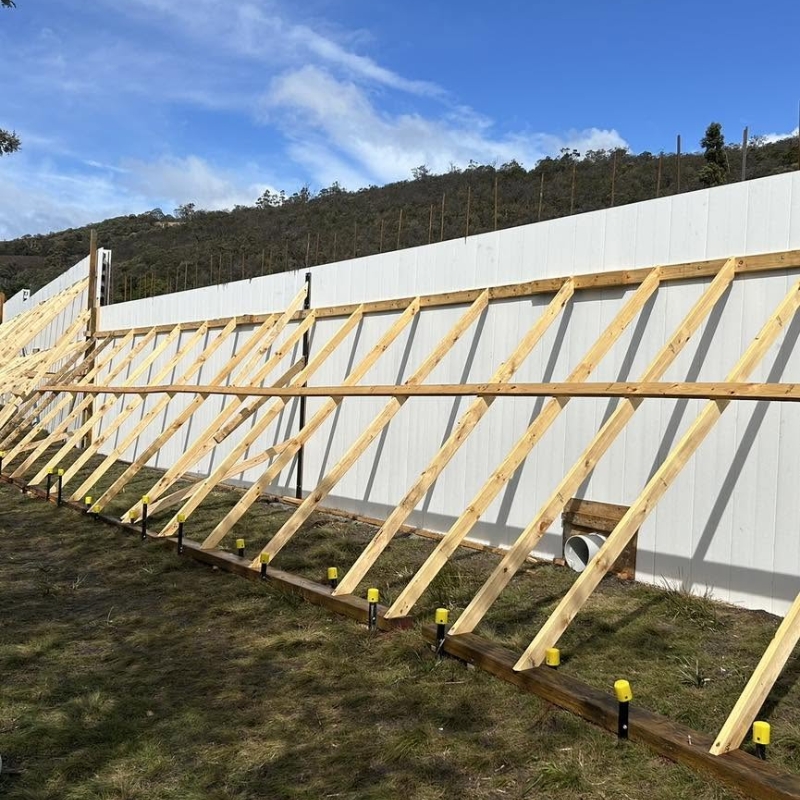
Urban infill and steep coastal blocks leave builders hunting for every spare millimetre. Excavators have no room to swing, spoil removal is slow and the neighbours want their fence back yesterday. On sites like these a block retaining wall can stall the programme for weeks. A permanent formwork retaining wall does not, because it removes the slowest steps entirely and installs up to 70% faster than blockwork.
That is not a marginal gain. It is the difference between backfilling in week one and backfilling in week three, and on a fixed-price contract every one of those days is margin.
Why tight sites punish blockwork
A block retaining wall is a slow, labour-heavy sequence and every step of it needs space. Set out, lay the blocks course by course, core fill, then render. Blocklayers need clearance on both faces to work. The blocks themselves arrive as heavy, bulky pallets that have to sit somewhere, and on a constrained site there is nowhere for them to sit. Then the wall gets a waterproofing membrane, because a porous block wall in wet clay is a callback waiting to happen.
Traditional in-situ formwork has the opposite problem and the same result. The wall pours quickly, but the crew builds a temporary box, waits, then pulls the whole thing apart and carts it away. You pay a skilled formwork crew twice for one wall.
Both systems are slow because both are multi-step. That is the thing worth fixing.
How a permanent formwork retaining wall works
Rise Wall is a lay-flat, stay-in-place PVC formwork system. The panels arrive flat, which is where the freight and storage advantage starts, and the on-site sequence is short:
- Stand and lock the panels to form the wall
- Fix the reinforcement inside the cavity
- Brace, then pour the concrete
There is no block-by-block construction, no render coat and no formwork to strip, clean and return. The PVC stays as the permanent face of the finished wall and does the water resistance work at the same time. Panels cut and adjust on site with standard tools, so a step-down, a service penetration or an awkward corner is handled by the crew already there.
See how the system is applied across retaining walls and other structural applications.
Speed: up to 70% faster than a block retaining wall
Blockwork rises at the speed of one bricklayer laying one block. There is no way to compress that. A permanent formwork retaining wall stands as a panel system, so the wall goes up in a fraction of the time and moves straight to reinforcement and pour with no rendering cycle behind it.
On a tight site, speed compounds. The wall is the thing everything else is queued behind. Clear it faster and the excavator leaves, the landscaper starts backfill, the fence goes back up and the neighbours stop calling. Faster install is not a product benefit, it is a programme benefit, and a programme benefit is a cost benefit.
Cost: up to 30% lower installed
The number that matters is the installed cost of the finished wall, not the price per panel. On that measure a permanent formwork retaining wall lands up to 30% below the alternatives, and the saving comes from four places:
- Less labour, because the install is simpler and the crew is smaller
- Less bracing, because the system is stronger and holds its line under pour pressure
- Less steel, because the system carries more of the load itself
- Less freight, because lay-flat panels ship far denser than block
Compare that to blockwork, where most of the cost is a licensed trade standing on the site for weeks, plus a render coat, plus a membrane. Price the wall in place and the gap is not close.
Freight and storage: 5 times more wall per load
This is the advantage tight-site builders feel first. Because the panels lay flat, a single load carries up to 5 times more wall area than a bulky, non-lay-flat system. Same truck, five times the wall.
On a constrained block that means the material stack shrinks to a flat pack instead of swallowing the only clear ground you have. Fewer truck movements means less disruption on a narrow street. And on a remote or regional job, where freight runs are infrequent and expensive, five times the density changes the maths on the whole package.
Strength and bracing
A Rise Wall is a reinforced concrete core inside a permanent PVC skin, which makes it around twice as strong as blockwork. On a retaining wall, where the whole job is resisting soil pressure, that matters structurally. During construction it matters commercially.
A stiffer system moves less during the pour, so it needs less bracing. Props are fixed to every second panel at roughly two thirds of the panel height, which is a fraction of the temporary works a block or traditional formwork wall demands. Less bracing means less material on site, less labour installing and removing it, and a straighter, more consistent finished face because the wall holds its own line.
Strength, bracing, speed and cost are one chain here, not four separate claims.
Water resistance: up to 70% less waterproofing
Retaining walls sit against wet ground for their entire life, and blockwork is porous. Water tracks through the blocks and through the mortar joints, which is why a block retaining wall needs a full external membrane and why remedial waterproofing is one of the most common callbacks in residential construction.
PVC does not absorb water. A Rise Wall is a highly water resistant system that typically requires around 70% less waterproofing than blockwork, which strips out both the membrane material and the labour to apply it. On a coastal block with a high water table, or a retaining wall tying into a basement, that is the difference between a wall that performs and a wall you go back to.
More detail on the water resistant permanent formwork wall system and where it suits in-ground applications.
Waste and site cleanliness
Blockwork leaves broken blocks, mortar spoil and packaging across ground you do not have. Traditional formwork leaves damaged ply in a skip. A lay-flat system runs leaner: material usage is lower, offcuts are reusable rather than binned, and there is no strip-out phase dumping used formwork on the slab. On a site where the only clear space is the driveway, a clean job is not a nice-to-have.
Block retaining wall vs permanent formwork
| Aspect | Block retaining wall | Rise Wall permanent formwork |
| Install speed | Slow, laid block by block | Up to 70% faster |
| Installed cost | High labour component | Up to 30% lower |
| Trade sequence | Set out, lay blocks, core fill, render | Set out, stand panels, reinforce, pour |
| Crew | Licensed blocklayers | General site crew, no specialists |
| Bracing | Extensive | Less bracing, props to every second panel |
| Strength | Baseline | 2 times stronger than blockwork |
| Waterproofing | Porous, external membrane needed | Up to 70% less waterproofing |
| Freight and storage | Heavy, bulky pallets | Lay flat, 5 times more per load |
| Waste | Broken blocks, mortar spoil | Minimal, offcuts reusable |
Matching the system to a constrained site
| Tight-site constraint | How Rise Wall answers it |
| No room for a blocklaying crew to work both faces | Panels stand and lock from one side, then pour |
| Nowhere to stack materials | Lay-flat packs store 5 times denser than block |
| Neighbours and access windows | Up to 70% faster install clears the site sooner |
| Water table or wet clay pocket | Highly water resistant, up to 70% less waterproofing |
| Blocklayers booked out for months | No specialist trade required |
Design and compliance
Engineers ask about structural behaviour before they ask about speed, and the answer is straightforward. The finished element is a reinforced concrete wall, so it is designed as one. The wall acts as a cantilever off the footing, or as a propped cantilever where a slab ties in, and soil pressure is assessed against the usual retaining wall design standards. The permanent PVC skin does not reduce concrete cover.
Rise Wall is fully tested and certified to comply with concrete formwork standards, and the certification documentation is available to give certifiers what they need without additional lab work.
For bracing and strike requirements on Australian sites, the Safe Work Australia formwork code of practice is the reference point.
Where permanent formwork earns the most
- Boundaries sitting less than a metre from the cut face
- Retaining walls tying into a basement slab
- Wet ground, coastal clay or a high water table
- Blocklayers are booked out months ahead
- Remote and regional jobs where freight runs are scarce
Two or more of those conditions, and the case is already made on the programme and installed cost.
The bottom line
A block retaining wall is familiar, and familiarity is the only column where it wins. A permanent formwork retaining wall installs up to 70% faster, costs up to 30% less installed, ships 5 times denser, stands twice as strong and needs up to 70% less waterproofing. On a tight site, where space and time are the two things you cannot buy, that is not a close call.
Request a quote and we will price the wall in place, not the panel.
Frequently asked questions
Is permanent formwork suitable for retaining walls?
Yes. The finished element is a reinforced concrete wall inside a permanent PVC skin, designed against the same retaining wall principles as any cast-in-situ wall, with the added benefit of water resistance built into the face.
How much faster is permanent formwork than a block retaining wall?
Rise Wall installs up to 70% faster than blockwork because it removes block-by-block construction and the render coat entirely.
Does a permanent formwork retaining wall still need waterproofing?
It typically needs around 70% less waterproofing than blockwork. PVC does not absorb water, so the wall is highly water-resistant when installed according to the recommended process.
Does it need bracing?
Yes, but less than blockwork or traditional formwork. Formwork props are fixed to every second panel at roughly two-thirds of the panel height, before the pour.
Do I need a specialist crew?
No. A general site crew can install the system. There is no licensed blocklaying trade to book and no formwork carpenter to schedule around.