



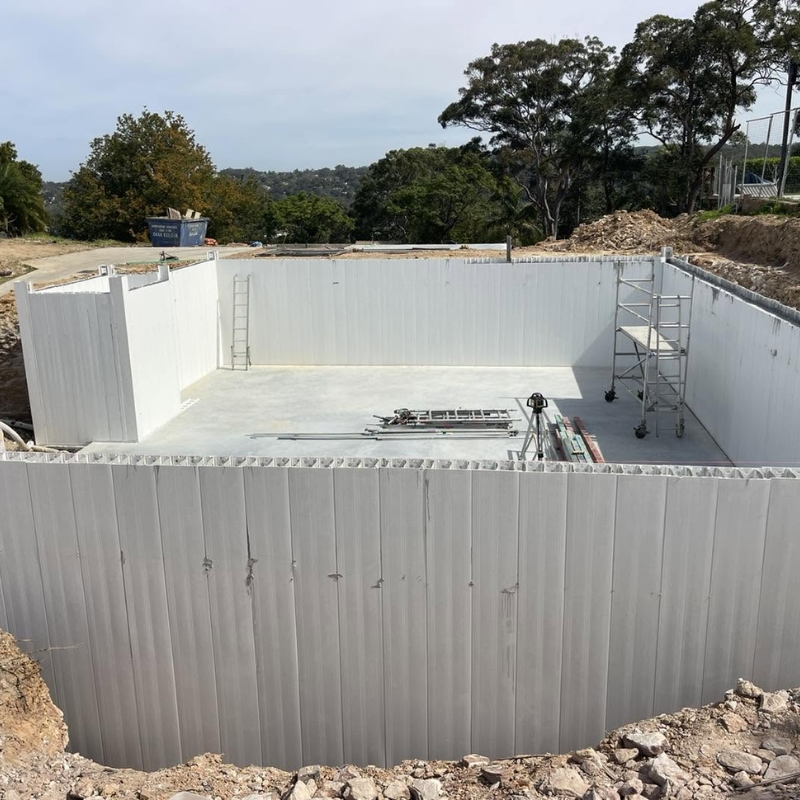
Most walls on Australian sites still go up one of two ways. Either a bricklaying crew lays blockwork course by course, or a formwork crew builds a temporary box, pours it, then pulls the whole thing apart again. Both work. Both are slow, labour-hungry, and expensive by the time the wall is finished and the site is cleaned up.
Lay-flat PVC formwork was built to remove those steps. It is a permanent formwork system that installs up to 70% faster, cuts total installed cost by up to 30% and ships five times more wall area per load than bulky, non-lay-flat alternatives. This article sets it against the systems most builders are still using, and shows where the savings actually come from.
How the system works
Lay-flat formwork is a stay-in-place system. The panels arrive flat, which is where the freight and storage advantage begins. On site the sequence is short:
- Stand and connect the panels to form the wall profile
- Install reinforcement inside the cavity
- Pour the concrete
That is the whole process. There is no formwork to strip, no panels to clean, no props to remove and return. The PVC stays as the permanent face of the wall and does the waterproofing work at the same time. Panels cut and adjust on site with standard tools, so openings, step-downs and awkward corners get handled by the crew already there rather than a specialist trade.
For a broader view of how the Rise formwork system fits into a build programme, start here.
Speed: up to 70% faster install
Blockwork is a repetition problem. Every block is placed, levelled and mortared by hand, and the wall can only rise as fast as a bricklayer can lay it. Traditional formwork has the opposite problem. The wall itself is quick to pour, but the build up and strip down either side of the pour is where the days disappear.
Lay-flat removes both bottlenecks. There is no block-by-block construction and no stripping phase. Because the panels are light and stand quickly, the wall is ready for reinforcement and pour in a fraction of the time, which is where the up to 70% faster install figure comes from.
Speed is not a vanity metric on a construction site. A wall that stands in two days instead of six releases the trades queued behind it, shortens the critical path and brings the completion date forward. Every day saved on the wall is a day of preliminaries, hire and supervision that never gets billed.
Cost: up to 30% lower installed
The number that matters is not the panel price. It is the installed cost of a finished wall, and that is where lay-flat separates from the alternatives by up to 30%. The saving is assembled from four places:
- Less labour, because the install is simpler and the crew is smaller
- Less bracing, because the system is stronger and holds line under pour pressure
- Less steel, because the system carries more of the load itself
- Less freight, because flat panels ship five times denser
Compare that to blockwork, where the majority of the cost is a licensed trade standing on site for weeks, or traditional formwork, where you are paying a crew twice, once to build the form and once to take it away. Judge any system on the total cost of the wall in place. On that measure the gap is not close.
Labour and simplicity
Lay-flat is a builder-friendly system, and that phrase is doing real work. No specialist crews are required. There is no bricklaying licence to book and no formwork carpenter to schedule around. A general site crew can be shown the system and be productive on the same wall.
The handling is simpler too. Panels are light enough to move without a crane on most walls; they are cut on site, and the step count from delivery to poured wall is short. Fewer steps mean fewer things to sequence, fewer things to wait on and fewer things to get wrong. In a market where skilled labour is the hardest thing to secure, a system that does not depend on a scarce trade is a scheduling advantage before it is a cost advantage.
Freight and storage: five times more per load
This is the advantage most builders underestimate until the first delivery lands. Because the panels lay flat, a single load carries up to five times more wall area than a bulky, non-lay-flat system. Same truck. Same fuel. Five times the wall.
The knock-on effects run right through the job:
- Transport costs fall because you are paying for a fraction of the truck movements
- Remote and regional projects become viable, since fewer freight runs mean less exposure to long-haul rates and delivery windows
- Storage on site shrinks to a flat stack, freeing slab space for reinforcement and services
- Site congestion and double handling drop because there is simply less bulk to shuffle
Blockwork and traditional formwork both arrive as heavy, bulky freight, and both need somewhere to sit. On a constrained site, that space is not free, and on a regional job, those truck movements are not cheap.
Strength: twice the strength of blockwork
A lay-flat wall is a reinforced concrete core inside a permanent PVC skin, which makes it around twice as strong as blockwork. That strength is not an abstract structural bragging right. It pays out during construction.
A stronger, stiffer system moves less during the pour. Less movement means less reliance on bracing, and less bracing means less material on site, less labour installing and stripping it, and less cost. It also means a straighter, more consistent wall face, because the system holds its line rather than being wrestled into it. Strength, bracing, speed and cost are not four separate benefits here. They are one chain.
Water resistance and durability
PVC does not absorb water. Blockwork does. That single difference is why lay-flat is a highly water resistant system that can require up to 70% less waterproofing than a comparable blockwork wall.
Blockwork walls leak through mortar joints, through the blocks themselves and through any spot where the membrane was rushed. Every one of those joints is a potential remedial callback, and remedial waterproofing on a finished basement is the most expensive water you will ever deal with. A permanent PVC face removes most of that risk from the outset, which is why the system suits basements, retaining walls and underground structures where a leak is not a cosmetic problem.
Water ingress is one of several recurring site risks worth designing out early. See The Four Challenges Facing Construction Sites for the wider picture.
Waste and site cleanliness
Traditional formwork generates waste as a matter of routine. Ply gets cut, used, damaged and skipped. Blockwork leaves broken blocks, mortar spoil and packaging across the site.
Lay-flat runs leaner. Offcuts are reusable rather than binned; overall material usage is lower because the system does more with less, and the site stays cleaner because there is no strip-out phase dumping used formwork on the slab. Less waste is less skip hire, less disposal cost and less labour spent tidying up after a trade that has already left.
System comparison at a glance
| Factor | Lay-flat PVC (Rise) | Blockwork | Traditional formwork |
| Install speed | Up to 70% faster | Slow, block by block | Multi-step, strip and clean |
| Installed cost | Up to 30% lower | High labour load | High labour load |
| Crew | General crew, no specialists | Licensed bricklayers | Formwork carpenters |
| Bracing | Minimal | Extensive | Extensive |
| Freight | 5 times more per load | Heavy, bulky pallets | Bulky panels and props |
| Stripping | None, stays in place | Not applicable | Required |
| Water resistance | Up to 70% less waterproofing | Porous, leak-prone | Depends on the wall finish |
Where lay-flat lands on real jobs
The system is not a general-purpose product looking for a home. It is strongest in the places where blockwork and traditional formwork are weakest.
- Retaining walls, where blockwork is slow to stand and prone to seepage
- Basement walls, where waterproofing failure is expensive, and lay-flat cuts the membrane load by up to 70%
- Residential builds, where programme pressure is constant, and specialist crews are hard to book
- Load-bearing walls, where the twice-the-strength figure earns its keep
- Remote and regional projects, where five times the wall per load changes the freight maths entirely
| Site scenario | Best fit | Why |
| Remote or regional project with limited freight runs | Lay-flat | Five times the wall area per load and a smaller crew to accommodate |
| Basement wall below the water table | Lay-flat | Highly water resistant system, up to 70% less waterproofing than blockwork |
| Residential retaining wall | Lay-flat | No bricklaying crew, cuts and adjusts on site, faster to stand |
| Load-bearing walls on a tight programme | Lay-flat | Up to 70% faster install with no formwork to strip afterwards |
| Constrained inner-city site | Lay-flat | Panels stack flat, less site congestion, fewer crane lifts |
Before you order
- Price the wall in place, not the panel. Labour, bracing, steel and freight are where the 30% sits
- Count the days the wall takes off your programme, then cost those days honestly
- Check what your current system is costing you in waterproofing and remedial risk
- Plan bracing during design, not on the slab
- Confirm your bracing and strike approach against the Safe Work Australia formwork code of practice
The Safe Work NSW formwork code of practice is the reference point for bracing and strike times on Australian sites.
The bottom line
Blockwork and traditional formwork are familiar, and familiarity is the only column where they win. On install speed, installed cost, labour, freight, strength, waterproofing and waste, a lay-flat permanent formwork system is ahead on every measure that shows up in a project budget.