



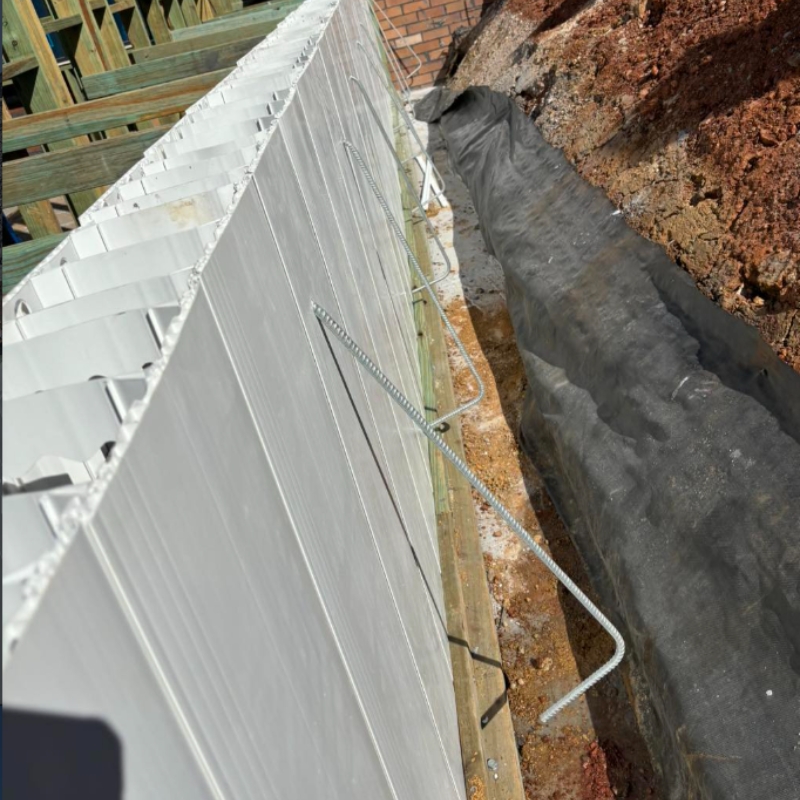
Soil movement is one of the quietest threats to a property. Left unchecked, a sloping site sheds soil with every heavy rain , undermining foundations, cracking paving, washing out gardens, and carrying sediment into drains and waterways. A well-built retaining wall stops that movement at the source. This article explains how Rise Products retaining wall panels stabilise slopes by resisting lateral ground pressure, while installing far faster than traditional blockwork.
Planning a wall for a sloping site? See our retaining walls page for the full Rise Wall system and applications.
Why slopes erode in the first place
Soil sits naturally at a limited angle, its angle of repose. Cut into a slope or load the ground above it, and gravity starts pulling that soil downhill. Water accelerates everything: rainfall runoff carries loose particles away, and saturated soil becomes heavier and pushes harder against whatever is in its path. Over time, this shows up as slumping ground, exposed footings, damaged landscaping, and sediment where you don’t want it. The two forces a retaining wall has to manage are clear: the lateral pressure of the soil pushing outward, and the water moving through and over it.
How a retaining wall stops the movement
A retaining wall holds soil at a steeper, more stable face than it could maintain on its own. To do that reliably, it needs to:
- Resist lateral earth pressure. The wall has to carry the horizontal load of the retained soil, and that load rises sharply when the ground behind it is saturated.
- Manage water. Proper drainage behind the wall relieves hydrostatic pressure and stops water from carrying soil out through the structure. Without it, even a strong wall can be undermined.
- Stay continuous. Gaps and joints are where soil escapes, and water finds a path, so the fewer weak points the better.
Why modular reinforced-concrete panels outperform blockwork
Rise Wall is a permanent formwork system: the modular panels are assembled on site, reinforced, then filled with concrete to form a single monolithic reinforced concrete wall. That construction method is what makes it so effective against erosion.
- One continuous structure. Unlike segmental blockwork, which relies on many stacked units and the joints between them, a poured Rise Wall acts as one reinforced element. Fewer joints means fewer paths for soil and water to escape, and a wall that resists lateral pressure as a single unit.
- Accurate, compliant reinforcement. The system’s triple reinforcement cradles and two-piece corner design keep steel positioned correctly, so the wall is engineered to handle the real structural demands of retaining applications rather than relying on the friction of stacked blocks.
- Water resistance is built in. The water-resistant version of Rise Wall stands up to moisture and helps keep the retained ground stable, reducing seepage and the slow erosion that happens behind weaker walls.
The result is a retaining wall that does both jobs at once, holding the slope against pressure and keeping water from washing soil away.
Faster than blockwork, which matters on an eroding site
Speed isn’t just about labour cost on a retaining job; it’s about getting the slope protected before the next big rain. Rise Wall is built to go up quickly:
- The patented lay-flat panels let you fit up to five times more formwork per delivery, a real advantage on tight or remote sites where access and storage are limited.
- Installation is significantly faster than blockwork, with panels that cut and assemble on site and a single continuous pour rather than course-by-course laying.
- Because the formwork stays in place, there’s nothing to strip afterwards, so the wall is complete and working sooner.
For exposed or freshly cut slopes, that faster timeline directly reduces the window in which erosion can take hold.
Protecting your slope and your property value
Erosion rarely stays a landscaping problem. Once soil starts moving, it threatens footings, retaining structures, paving, and drainage, and reversing the damage costs far more than preventing it. A modular Rise Wall retaining wall stabilises the slope, manages the water, and resists the ground pressure that drives erosion, installed fast enough to protect the site before the weather tests it. Using modular panels prevents erosion and protects the long-term value of the property they’re built to defend.
Building a retaining wall on a sloping or erosion-prone site? Talk to Rise Products about the right Rise Wall solution for your project.