



Labour is the biggest variable on a concrete wall job. Material prices are easy to track, but crew hours can blow out when weather, access or rework creep in. With tradies hard to book across Australia and the United States, builders are asking a simple question: stick with traditional blockwork or move to a permanent formwork system that stays in place after the pour?
Early adopters of permanent formwork systems report install speeds that surprise even seasoned foremen. Let’s look at why the labour gap is growing and where each method still has a place.
What Really Drives Crew Hours
Three factors account for most labour time on a basement or retaining wall:
- Handling and staging of materials on tight sites
- Time spent setting out straight, plumb walls
- Rework caused by voids, misaligned cores or poor compaction
Neither method escapes these issues entirely, yet each addresses them differently. The comparison below focuses on an 80 m² single-sided wall, the kind you see on a split-level home or small commercial lift shaft.
Blockwork: Familiar but Labour-Intensive
Blockwork is the known quantity. Every bricklayer understands 20.01 kg hollow concrete blocks, 10 mm mortar beds and the rhythm of three courses per hour. That familiarity, though, hides unavoidable steps:
- Pallets of blocks must be craned or forklifted close to the wall line. On tight urban lots, that often means double-handling.
- Mortar mixing, re-mixing and clean-up add a low-skill labour tier that still costs money.
- Core filling is a separate pass, typically with a small pump and two hands on the hose. Any missed cell means an inspection fail and another visit.
Realistically, a crew of three lays about 12 m² of blockwork a day once staging, breaks and site inductions are counted. Overtime becomes the pressure valve when bad weather steals hours.
Permanent Formwork: Panels that Stay Put
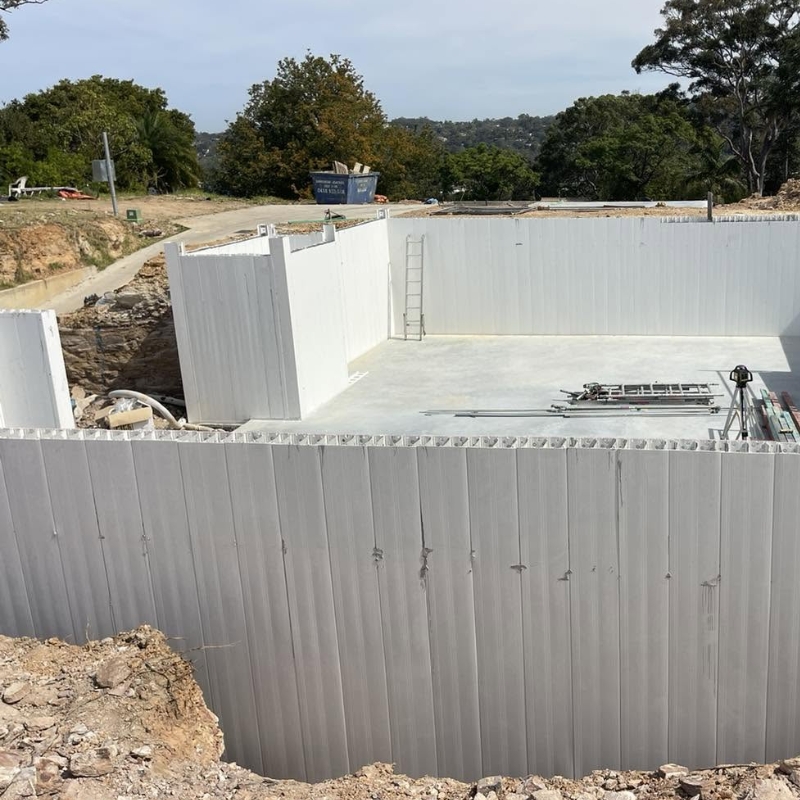
Permanent or “stay-in-place” formwork uses lightweight fibre-cement or EPS-cement panels that lock together like shiplap. Steel reinforcement threads through pre-formed slots, and concrete is pumped into the cavity in one pass. Labour savings flow from the basics:
- Panels weigh under 15 kg, so one installer carries them without machinery.
- No mortar, no core fill day, no acid wash.
- The wall lines itself; tongue-and-groove edges act as spacers, cutting layout checks in half.
An experienced two-person crew often tops 25 m² a day on the same wall footprint. Even the first-time user hits 18–20 m² after a short manufacturer briefing.
A mid-2025 townhouse project in Newcastle shows the difference clearly. The builder costed 110 hours for blockwork but switched late to permanent formwork and logged 62 labour hours, a 44% reduction. The crew poured on Friday and stripped bracing Monday morning, three days ahead on the programme.
Mid-Project Challenges Builders Mention
Labour control isn’t the only talking point. A scan of reader emails on our earlier post, The Four Challenges Facing Construction Sites, highlights two recurring concerns:
- Skill shortage — Many sites can find general labourers but struggle to book licensed bricklayers for consecutive days.
- Wet-edge deadlines — Councils in coastal zones insist on rapid close-up of exposed trenches. The longer a block wall sits half-built, the higher the storm-water risk.
Permanent formwork answers both. Less reliance on specialist trades widens the hiring pool, and the pour-and-backfill cycle shrinks to one inspection window.
Where Blockwork Still Makes Sense
Permanent formwork is not a silver bullet. Blockwork holds ground in niche scenarios:
- Small repairs under 10 m² — Buying a full pack of panels and proprietary ties rarely stacks up for patch jobs.
- Extreme fire exposure — While approved systems carry fire ratings, some specifiers still default to 140 mm solid blocks right beside a boundary line.
- Owner-builder familiarity — Hobby renovators understand blockwork and may favour a method they can DIY over weekends.
For commercial or multi-res projects, however, repetitive walls magnify every saved minute. At 50 m² per townhouse and eight units per site, permanent formwork cuts roughly 400 crew hours — enough to reassign the gang to fit-out weeks earlier.
Counting the Dollars
Laboratory costings are rare, but on-site observations point to the following pattern:
| Wall Size | Crew Size | Blockwork Hours | Permanent Formwork Hours | Typical Saving |
| 20 m² lift pit | 2 | 38 | 24 | 37% |
| 80 m² basement wall | 3 | 120 | 68 | 43% |
| 200 m² podium podium | 4 | 260 | 145 | 44% |
Material outlay is often similar when freight is considered. Panels pack flat — 200 m² fits on one truck, while blockwork may need two. Fewer deliveries reduce crane bookings and traffic management fees, sweetening the real saving.
Compliance and Safety Hurdles
Both systems satisfy AS 3600 concrete design rules, but inspection routines differ. Blockwork must show filled cores at nominated intervals. Permanent formwork, on the other hand, asks for bracing checks pre-pour and cavity visibility strips post-pour. Crews appreciate standing well clear of a pump line instead of lugging blocks up makeshift scaffolds, a point reinforced by recent Safe Work Australia guidance.
Insurers now lean towards systems that cut manual handling injuries. Lightweight panels tick that box and may nudge premiums down after a demonstrated injury-free run.
Choosing the Right Fit for Your Next Wall
Start with the programme. If the critical path is already tight, shed days by skipping mortar curing and core-fill delays. Next, review access. A narrow laneway that stops a telehandler from getting near the wall screams for flat-pack panels. Finally, weigh up labour market reality. Even metropolitan Melbourne loses bricklayers to infrastructure projects for weeks at a time. Being able to train general hands to install formwork in half a day is insurance against those gaps.
Projects chasing heritage aesthetics or exposed block textures will always keep block masonry alive. Everything else is swinging towards systems that lock up faster, drain fewer labour hours and push concrete placement into a single inspected event.
Bottom line: permanent formwork cuts labour by roughly one-third to one-half on walls over 20 m². As labour scarcity turns chronic across Australia and the United States, that margin is too big for most builders to ignore.