



Build Time on a Real-World Schedule
Commercial builders juggling compressed programs rarely forgive tasks that overrun. Traditional concrete blockwork demands sequential trades: footings one week, blocklayers the next, core-filling after inspection, waterproofing later. Even on a tightly choreographed site, it can swallow a fortnight.
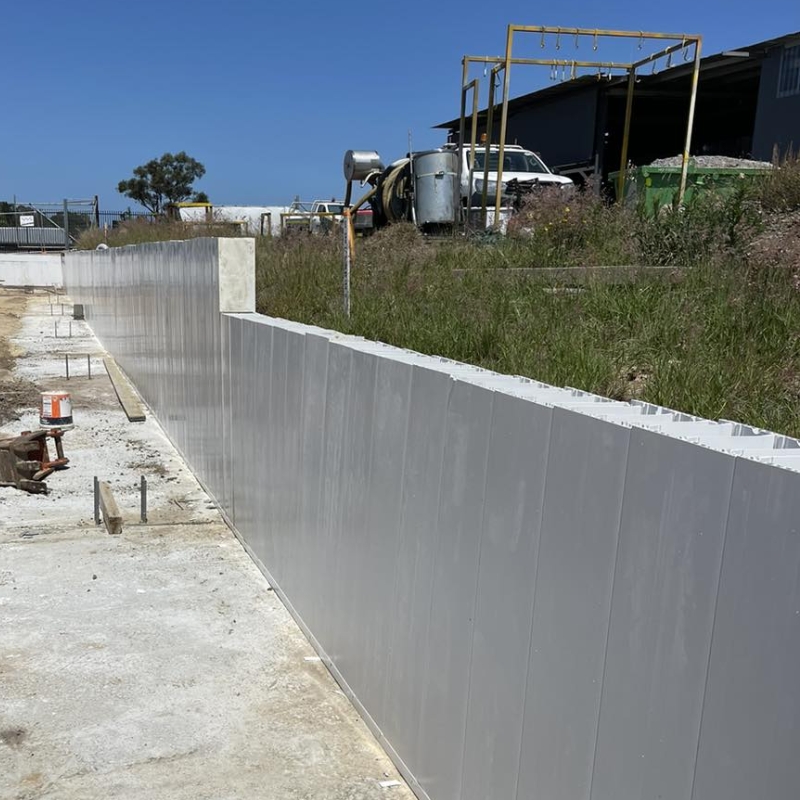
By contrast, proprietary lay-flat permanent formwork arrives as interlocking fibre-cement or composite panels. Crews clip panels together, set reinforcement, and pour concrete straight away. Many contractors report the structural pour happening two to three days after footings – roughly a 70 % cycle-time saving. On multi-rise basements, that difference can push the entire critical path forward. If timelines are already strained, exploring a faster retaining wall approach makes immediate sense.
Installation Practicalities on Site
Blockwork feels familiar, yet it carries hidden frictions. Pallets of blocks claim precious lay-down space. Wet weather halts laying because mortar performance drops. Achieving plumb alignment over three or four metres of height demands skilled brickies, and those trades are in short supply across both Australia and the United States.
Lay-flat formwork turns most of that labour into mechanical handling. Packs arrive flat-stacked, easing crane lifts into confined basements. Panels click together with female-male edges, so alignment is governed by the mould rather than the individual’s eye. Because panels act as the form face, there is no need for strip-formwork removal, allowing follow-on trades to waterproof or backfill sooner. Sites that struggle to book bricklayers praise the system for re-allocating work to general concreting crews already on standby.
Cost Variables Beyond the Purchase Price
Pure materials comparison can mislead. Blocks often look cheaper per square metre at the merchant. Once the ledger includes labour, crane time and temporary props, the gap narrows quickly.
Table 1 illustrates where the dollars typically shift. Values are indicative only; every site must run its own take-off.
| Cost driver | Concrete blockwork | Lay-flat permanent formwork |
| Skilled labour hours | High – bricklayers plus labourers | Lower – concreters and labourers |
| Crane picks | Multiple pallets + strip-formwork returns | Fewer flat packs, no retrieval |
| Waterproofing | Full height membrane | 30-50 % reduction (panel face remains) |
| Debris disposal | Broken blocks, mortar bags | Minimal off-cuts |
| Programme float | Weather dependent | Pour can proceed in light rain |
Notice how the softer allowances, such as crane hire extensions and wet-weather downtime, can snowball. Many estimators add a provisional sum rather than a hard number, which can hide the real premium. Like spotting retaining wall failure signs before they become major repair issues, identifying hidden project costs early helps prevent expensive surprises. For regional projects where crane mobilisation already hurts, formwork panels tend to win outright.
Engineering Performance Over Decades
Specifiers sometimes worry that a “panel” solution may compromise structural integrity. In practice, lay-flat systems behave like an engineered single-face form. Reinforcement cages sit centrally; concrete fills the cavity monolithically. Once cured, the wall is a homogeneous structure comparable to a cast-in-situ pour.
Durability testing under AS 3600 and ASTM C1185 shows panel-faced walls matching or exceeding blockwork for compressive strength. Because joints are cast, there are fewer vertical mortar planes – the weak points that typically invite moisture ingress. Some engineers now specify permanent formwork when salt-laden winds or aggressive soils threaten long-term durability.
From a maintenance standpoint, inspectors appreciate the consistent surface. Efflorescence is easier to spot, patch repair is straightforward, and graffiti removal is less abrasive than on porous block faces.
Guidelines from state regulators support both systems when properly detailed. The QBCC advice on preventing structural damage highlights drainage and backfill as the dominant failure causes, not the wall medium itself. In other words, execution quality trumps material choice.
Situations Where Each Method Shines
Neither system owns every scenario. Understanding the project drivers clarifies which route delivers better value.
Urban basement digs with tight hoarding lines reward lay-flat formwork. Less lay-down space, accelerated waterproofing, and reduced trade traffic keep neighbours and certifiers happier. Design-and-construct contracts that impose liquidated damages for late delivery likewise favour the faster cycle.
Conversely, small retaining walls under one metre, where hand-placing blocks avoids plant hire and formwork procurement, still belong to traditional masonry. Heritage overlays sometimes insist on a block or brick face to match existing streetscapes; formwork panels would need an applied veneer that adds cost.
On remote projects, freight efficiency usually tips the scale. Panels travel dense and flat, halving truck movements compared with block pallets. Fewer trips mean fewer variables in the logistics chain – a bonus when border checks or weather closures bite.
Finally, workforce composition plays a role. If a builder already employs crews who specialise in blockwork, the marginal saving may shrink. Yet many firms report bricklayer scarcity stretching bids. The ability to redeploy readily available concreters can rescue schedules.
Choosing the Best Fit
Blockwork’s decades-long track record offers comforting predictability, but that familiarity can mask programme risk when labour or weather turns against you. Lay-flat permanent formwork flips the script: higher off-the-shelf spend, lower installed cost, and a speed edge that reverberates through the entire build.
Run a full life-cycle costing exercise for your next retaining wall, not just a line-item take-off. Factor in crane hours, membrane coverage, and lost days to rain. The numbers often surprise even seasoned estimators. Armed with realistic inputs, the decision becomes clearer and far less about tradition.
If tight deadlines or restricted sites dominate your brief, permanent formwork deserves a spot at the top of the shortlist. Where heritage aesthetics or under-one-metre heights rule, blockwork will probably stay. Either way, making the comparison early prevents redesign headaches once the ground is open.