



When a build is running on a tight program, every hour on the critical path counts. Two of the most common ways to deliver structural concrete walls, precast panels craned in from a factory, and walls poured in place on site, both promise speed, but they get there in very different ways. So which one actually gets your crew to lock up and fit out faster? The answer has less to do with the concrete itself and more to do with what each method does to your schedule before, during, and after the wall goes up.
Before comparing the methods, it helps to be clear on what’s being built. See our guide to internal load-bearing walls for how structural walls carry a building’s loads.
Where onsite poured walls spend your time
Poured-in-place walls are flexible and well understood, but the schedule cost is easy to underestimate:
- Curing wait. Once the concrete is poured, it has to reach strength before forms can be stripped and loads applied. That’s often a wait of several days per lift before work can continue, time that sits squarely on the critical path.
- Weather delays. Pours and curing are exposed to the elements. Rain, cold snaps, and extreme heat can push a pour back or compromise it, and you can’t always control when the window opens.
- Sequential progress. Each section typically waits on the one before it, so delays compound rather than absorb.
- Form stripping and make-good. Traditional formwork has to be removed and the surface made good, adding labour after the pour.
The result is a dependable method whose biggest weakness is time: curing and weather exposure are baked into every stage.
Where precast panels spend your time
Precast flips the problem by moving production off-site:
- Parallel manufacturing. Panels are cast in a controlled factory, so production can run while site works like foundations progress.
- No on-site curing wait. Panels arrive at strength and are craned into place, often in a matter of hours.
That sounds faster, and the erection itself is, but the time saving is frequently eaten elsewhere:
- Lead time. Shop drawings, factory scheduling, and manufacturing can take weeks before the first panel ships, and the design has to be locked in early.
- Transport and access. Finished panels often need wide-load permits and long hauls from the plant to the site.
- Heavy lifting. Cranes and machinery, site access, and traffic management all add cost and coordination.
- No flexibility. Once a panel is cast, it can’t be adjusted in the field. A clash or change means re-fabrication and a fresh wait.
So precast wins the erection sprint but can lose the overall race to lead time, logistics, and rigidity.
Where the time is really won or lost
| Onsite poured | Precast panels | |
| On-site curing wait | Several days per lift | None (cured off site) |
| Weather risk | High | Low during install |
| Pre-construction lead time | Low | High (shop drawings + manufacturing) |
| Transport and access | Standard materials | Wide loads permit |
| Equipment | Standard formwork | Cranes and heavy machinery |
| Field flexibility | High | None once cast |
Neither option is a clean win. On-site poured trades flexibility for curing and weather delays; precast trades flexibility for lead time and logistics. The fastest schedule comes from a method that keeps the speed of both while shedding their weak points.
A faster path: Rise Wall permanent formwork
Rise Wall is built to capture precast-style speed without the precast penalties, and without the curing and weather drag of conventional poured walls.
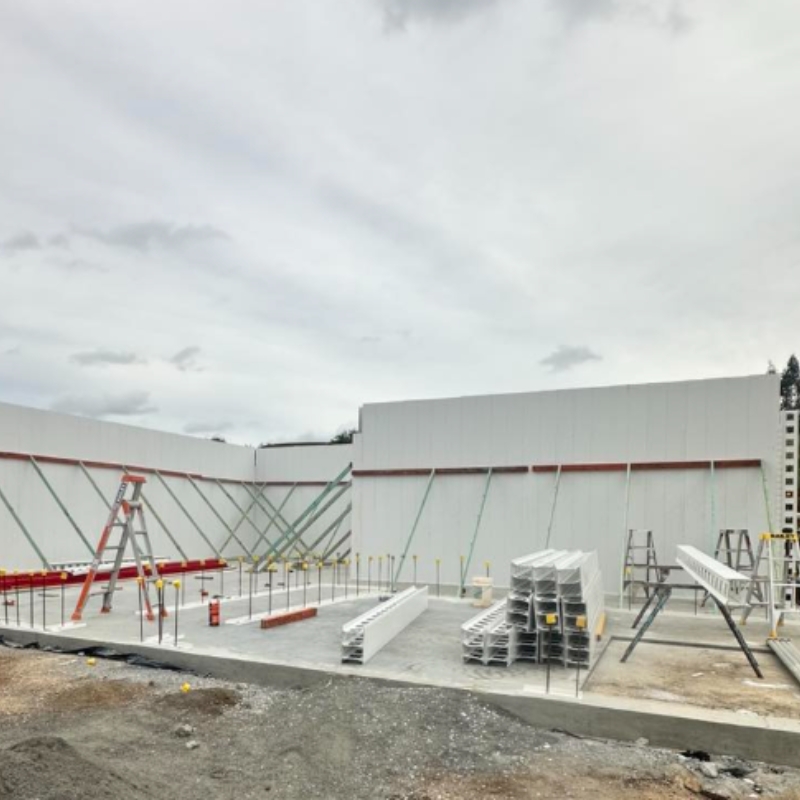
- Flat-pack delivery, no crane. The patented lay-flat panels let you fit up to five times more formwork per delivery and store it easily on site. There are no wide-load permits and no cranes or heavy machinery to schedule.
- No shop-drawing lead time. The standardised system removes the weeks of pre-construction drafting that precast requires, so you can start sooner.
- Adjust right up to the pour. Panels are cut and assembled on site, so clashes and changes are handled in the field, not sent back to a factory.
- Up to 4–5x faster installation. Rise Wall installs far quicker than blockwork or timber stud systems, then fills in a single, continuous monolithic pour.
- No stripping, less waste. The formwork stays in place, so there’s nothing to strip and up to 60% less form waste to remove.
Because the formwork never waits on factory production or on curing before it can be installed, and the pour is monolithic, the wall keeps moving, without the precast lead-time hit or the per-element curing-and-weather drag of conventional poured construction.
The bottom line
Framed as precast versus onsite poured, this is a trade-off with no clear winner: one costs you lead time and flexibility, the other costs you curing time and weather risk. Rise Wall sidesteps the choice, delivering the on-site speed and flexibility of poured construction with installation fast enough to rival precast erection. For teams under schedule pressure, that means days saved on the program and a faster path to fitout.
Building structural walls on a tight timeline? Talk to Rise Products about how Rise Wall can speed up your next project.