



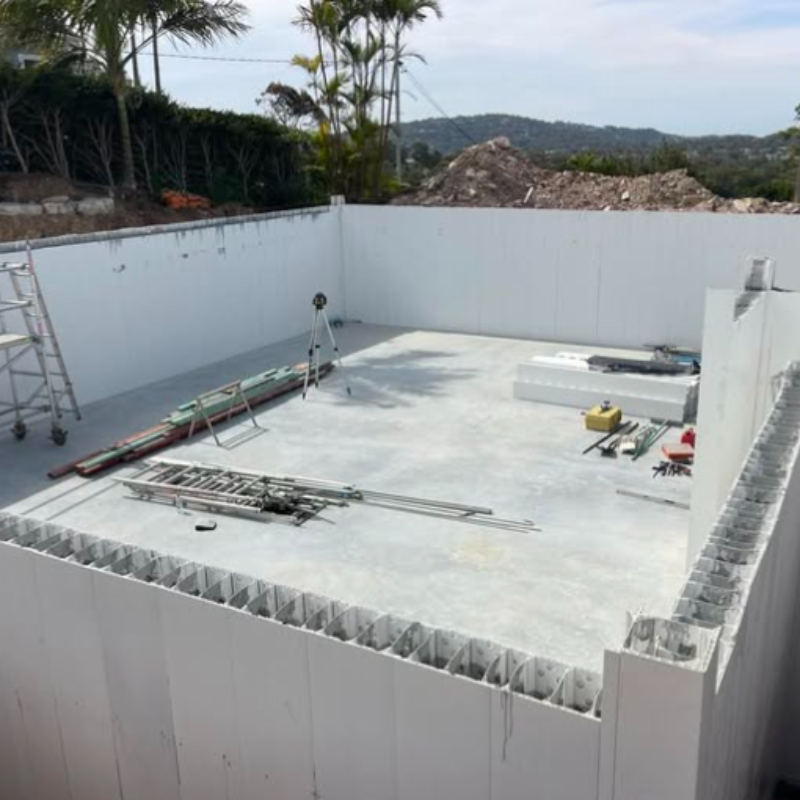
Concrete walls should not hold up a build schedule. Yet bulky panels, rows of props and large blocklaying crews still slow projects across Australia and the United States. A lay-flat permanent formwork system changes that equation. Arriving to site stacked flat, the panels hinge upright, stay in place after the pour and carry most of the concrete pressure themselves. The result is up to 70 % faster installation, around 30 % lower total installed cost and a much smaller labour footprint compared with blockwork or conventional PVC forms.
If you are planning a basement, retaining wall or core wall, understanding why bracing, labour and time all shrink with a lay-flat system will help you set realistic budgets and deadlines. The quick guide below explains the mechanics, references Safe Work Australia’s guidance on formwork safety and shows where the numbers come from. Throughout you will see why the Rise Wall permanent formwork system is earning repeat use on fast-track projects.
What Makes a Concrete Formwork System “Lay-Flat”?
A lay-flat system is engineered so the panels nest skin-to-skin for transport, then fold or slot into shape on site. Key design points include:
- Male-female interlocks for quick alignment
• Built-in spacers that set concrete cover without separate chairs
• High-strength ribs that double wall stability under fresh concrete pressure
• Modular corners and end caps that remove custom boxing
• A water-resistant face that needs up to 70 % less extra waterproofing
Because the packs travel flat, a semi-trailer can haul roughly five times more wall area than rigid PVC panels. On congested CBD sites that can be the difference between paying for a separate off-site lay-down yard or not. On remote projects it removes expensive dead-head truck kilometres.
Why Traditional Bracing Eats Time and Budget
Conventional formwork depends on external props to resist the hydrostatic force of wet concrete. Every prop demands measuring, drilling, fixing, checking and later stripping. On blockwork the labour drain looks different but still exists: horizontal braces keep walls straight until grout cures, taking time and adding clutter.
Beyond the raw hours, bracing also:
- Creates trip hazards that trigger safety audits
• Blocks other trades from accessing the slab edge
• Requires additional scaffold ties or ground anchors
• Generates patching tasks once the props come off
Formwork incidents linked to inadequate bracing remain a notable statistic in the Safe Work Australia information sheet on the topic. Fewer props mean fewer risk points and fewer inspection delays.
Internal Strength Means Fewer Props
A lay-flat panel’s rib profile is designed to carry most of the fresh-concrete load. Strategic corner and mid-run props are still prudent on tall walls, but the prop count is typically slashed by more than half. For a 30-metre-long, 3-metre-high basement wall, that can remove dozens of props and several crew-hours of fixing and stripping.
Bracing, Handling and Speed at a Glance
The table below compares three common wall systems on factors that directly affect program time, crew size and logistics.
| System | External Bracing Needed | Crew Handling Steps | Freight & Storage Density | Typical Install Speed |
| Lay-flat permanent formwork | Minimal strategic props | Unpack, unfold, lock panels, pour | Up to 5× wall area per truck | Up to 70 % faster |
| Rigid PVC formwork | Props every 1.2 m | Unpack bulky panels, align, brace, pour, strip | 1× baseline | 30–40 % faster than blockwork |
| Concrete blockwork | Horizontal alignment props | Deliver pallets, lay block by block, clean joints, cure, grout | 1× baseline | Slowest, labour-intensive |
*Based on averages from Australian low-rise and mid-rise projects where Rise Wall replaced the listed alternative.
Because the panels stay in place, stripping time and rehandling also disappear from the critical path.
Labour Efficiency: Building the Same Wall with Half the Crew
Labour shortages remain a pain point on both sides of the Pacific. A traditional blockwork wall might involve eight tradespeople once you count bricklayers, labourers, a spotter and a supervisor. Rigid PVC formwork still needs at least five hands: two installing, two bracing and one checking alignment.
A lay-flat wall regularly goes up with a four-person crew:
- Two installers positioning and interlocking panels
- One steel fixer placing reinforcement and sleeves
- One leading hand coordinating crane picks and quality checks
The smaller crew not only cuts wages but simplifies scheduling. When rain washes out a day, finding replacement labour for four roles is easier than recoordinating eight specialists.
Case Snapshot: Regional Health-Care Basement
A builder in far north Queensland faced six-hour round-trips to fly-in crews. Switching to lay-flat formwork kept the wall team to four people and saved nine programme days. The freed budget covered an extra concrete pour later in the schedule, pulling handover forward.
Where the “Up to 70 % Faster” Claim Comes From
The headline speed figure is an aggregate of three measurable savings:
- Freight and handling – five trailer loads compress into one, so fewer crane picks and fewer traffic-control windows.
- Installation – folding panels upright is faster than laying blocks or rigging bulky forms. Minimal bracing slashes set-out hours.
- No stripping – because the panel stays on the wall, follow-on trades access the surface as soon as the concrete gains strength.
Across 500 m² of wall, three weeks of blockwork regularly shrink to under one week.
Freight and Storage: Hidden Time That Adds Up
Stacking density rarely shows on the Gantt chart, yet it influences everything from crane time to site access.
| Advantage | Impact on Programme |
| 5× more wall per truck | Fewer deliveries, traffic control savings |
| Flat packs lifted by crane | One pick per 300 m², not 60 m² |
| Minimal lay-down area | Keeps slab clear for steel and MEP staging |
| Reduced return freight | No stripped forms to send back to the depot |
For builders working on tight inner-city footprints, the ability to store multiple floors of panels on one deck removes costly off-site storage leases.
Mistakes to Avoid When Moving to Lay-Flat Panels
Even a simpler system needs correct planning. The most common pitfalls include:
- Ordering conventional prop sets out of habit
• Use the supplier’s bracing calculator first; over-bracing cancels labour savings. - Skipping installer orientation
• A half-day toolbox on unfolding, joint sealing and cut-outs prevents rework. - Planning crane picks as if panels are rigid
• Flat packs allow larger, safer lifts. Land them directly where the crew starts. - Treating penetrations like blockwork chases
• Cut clean openings before the pour and install sleeves to avoid post-pour coring. - Under-allowing for concrete pressure on tall stepped walls
• Tall lifts may still need supplementary external props.
Avoiding these missteps ensures the projected speed and cost benefits turn up onsite.
Decision Framework: When Does Lay-Flat Permanent Formwork Pay Back Fastest?
| Project Characteristic | Lay-Flat Advantage | Outcome |
| Tight metro footprint | Five-to-one stacking density | Frees slab space, cuts crane swings |
| Remote or island logistics | Single load equals five | Freight and carbon kilometres drop |
| High water table or pool walls | Integrated water-resistant face | Up to 70 % less waterproofing |
| Labour-scarce regions | Four-person install crew | Lower day rates, easier scheduling |
| Fast-track programme | No stripping, fewer props | Parallel trades move in earlier |
If a project ticks two or more of these boxes, a lay-flat approach typically produces the strongest return on investment.
Key Questions to Ask a Supplier Before Committing
- What accredited test data supports the wall-strength and pressure ratings?
- Can you share case studies that quantify labour hours saved per 100 m²?
- Do you provide a bracing calculation service for site-specific pours?
- What installer training is included in the supply price?
- How many square metres can fit on a standard 12-metre Australian trailer?
Answers backed by data indicate a partner ready to support site teams, not just ship panels.
FAQs
1. Do lay-flat systems remove all external bracing?
No. They remove most intermediate props because the ribbed panel carries pressure, but long straight runs and high walls still need strategic bracing for safety and tolerance control.
2. How do labour savings compare with jump-form cores?
Jump-forms excel on repetitive high-rise cores yet need specialist crews and tower crane time. Lay-flat systems target basement, retaining and low- to mid-rise walls where fast hand-placement by a small crew offers bigger savings.
3. Is “up to 70 % faster” realistic on a small residential job?
Yes, provided the crew follows unfolding and joint-sealing guidelines. Builders regularly finish a 40-metre retaining wall in two days rather than a week of blockwork.
4. Does the PVC face compromise fire performance?
Rise Wall panels are manufactured from fire-retardant PVC that meets relevant NCC and UL standards. Always request copies of the test certificates for your building class.
5. Can panels be recycled at end of life?
Yes. Off-cuts are minimal, and most suppliers accept decommissioned panels for re-processing, helping projects meet circular-economy goals.
Final Thoughts
Lay-flat permanent formwork delivers a simple formula: fewer props, smaller crews and no stripping delays. When those savings combine, wall construction time falls by up to 70 % and installed cost drops by roughly 30 %. Add five-to-one freight efficiency and double wall strength and it is easy to see why builders from Cairns to California are swapping blockwork and bulky PVC for a fold-out system.
If you need concrete walls that hit programme milestones without swelling labour hire or bracing budgets, reviewing a lay-flat approach early in design can set the project on a faster, cleaner path.